
How does AI interpret university reputation?
Louise Simpson, Mark Sudbury, and Abi Kelly • 24 November 2026
Thumbnail image source: Caleb Jack, Unsplash
If a student or academic wants to find out more about a university, it is likely they will put a question to their computer and the answer will be written by AI, whether they like it or not. In the wake of this inescapable comms revolution, we are refining a methodology and measurement system, Reputation AI, to help universities understand their reputational performance in AI as a complement to more traditional areas of market research, such as stakeholder audits.
Our recent webinar summarised an innovative reputation project we have done for RCSI University of Medicine and Health Sciences, Ireland, commissioned by their Director of International Engagement and External Relations, Abi Kelly. She joined us to discuss the findings and explain their impact on reputation management at the university.
Firstly, she welcomed the key finding, the consistency of RCSI’s reputation in the Large Language Models (LLMs) powering the platforms analysed (Gemini and ChatGPT) and the five countries where we asked the research questions. This allowed her to show the leadership team that the global image was ‘hitting home in AI’ in their key markets. Having done a lot of work to communicate the university’s world rankings in the past few years, she was also really pleased that LLMs reflected the university’s global standing in the QS Subject Rankings as a top 150 university for medicine and health sciences and one of the most international medical schools in some of their main markets. It was encouraging to see that the university’s 2025 number 1 position in the world for the United Nations’ Sustainable Development Goal relating to Good Health and Wellbeing (SDG3) in THE Impact Ranking [1] was really prominent in Malaysia and Ireland.
RCSI’s teaching was also very positive in both LLMs, although Gemini was more nuanced than ChatGPT, which tended to be more blunt!
Teaching strengths were dominated by words such as ‘clinical and ‘international’, which gave Kelly useful evidence to show the teaching faculty that their work was really cutting through, but also supporting their communications efforts and prioritisation. However, some of the words the LLMs used to describe the university’s teaching strengths proved more exciting and differentiating than the content the university itself sometimes used. So we advised them to learn some of the wordsmithing tricks of AI!
For every reputation question we asked of the LLMs, we followed up with a fascinating question asking what sources they used. Most gratifyingly for Kelly was the finding that AI was scouring RCSI’s own publications and website. These were cited by AI more frequently than rankings and research citation data. ‘It was positive to find that so much of AI content is in RCSI’s own control!,’ said Kelly. ‘Few people tend to read a university annual report cover-to-cover, but now that we know that LLMs do and are summarising the main themes, our Comms Team has been more deliberate in this year's report in expanding the messages we want LLMs to pick-up on and to reflect back to our key audiences.’
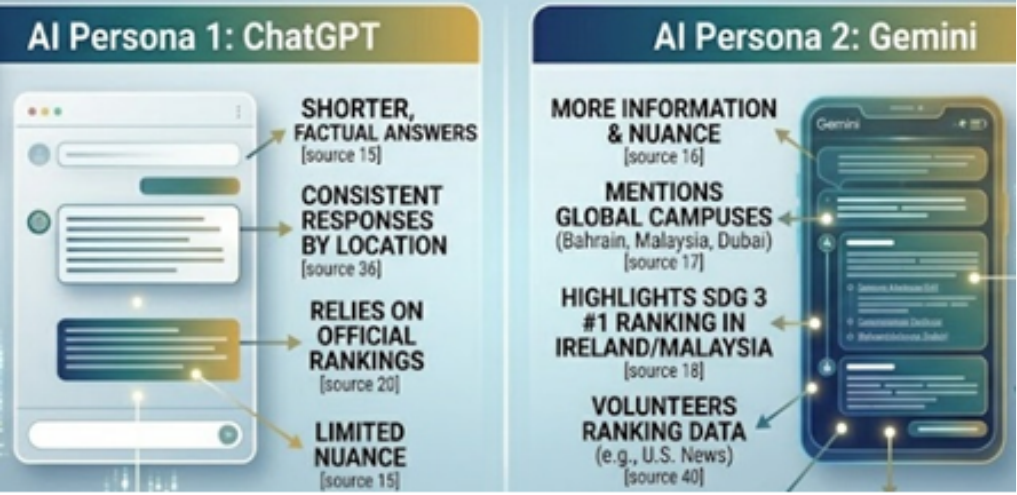
The differences in answers about RCSI's reputation between Gemini and ChatGPT (Higher Reputation Ltd, 2026)
This was underlined to Kelly because our research showed that not all of RCSI’s brand messages were being reflected by the LLMs. AI didn’t acknowledge their world-leading Respiratory and Lung research or in teaching, their new UG programme in Dentistry – despite, or perhaps because of, being a recent addition to their curriculum. But this gave communications and marketing teams the chance to agree the need for sharper, fewer and more consistent messages with senior leaders. Hearing this from independent and experienced higher education consultants also made it more powerful than an internal review, said Kelly, as the leadership took onboard an objective, evidence-based set of recommendations.
So whilst AI is transforming the communications sector, Kelly is very optimistic about it as a strong tool for marcomms teams. With AI’s focus on institutional publications, communicators can flex brand messages and influence reputation globally much more easily as a result. It lends them a greater ability to showcase their storytelling whilst also ensuring they remain ‘critical thinkers’ when assessing LLM content and information, vigilant of biases and inaccuracies. And because AI is omnipresent and the main source of user content, comms professionals also need to keep an active eye on it, especially at times of crises!
For information about Reputation AI and understanding your university reputation in LLMs, contact consultants@higherreputation.com